Defence software development
Build software for operational coordination and planning, or modernise a platform your organisation already relies on. Work directly with engineers who learn how your operations work and use that knowledge to shape the application.

What can we help you build?
Defence software needs to reflect how people coordinate activities and make decisions within their organisation. Drawing on our experience with ISMERLO, we can help you explore applications such as:
- 01
Operational coordination platforms
Give participating teams a shared place to exchange updates and follow the progress of an operation. The application can bring information from different organisations into a common workflow, with permissions that reflect each participant’s responsibilities.
- 02
Resource and deployment planning tools
Help planners compare ways to move equipment and resources where they’re needed. A planning application can account for different transport stages and practical constraints, while allowing specialists to review a proposed scenario and adjust its assumptions.
- 03
Map-based applications
Connect geographical information with the records behind it. Users can locate resources or infrastructure on a map, inspect relevant details and use that context when planning. The design should make clear how current the information is and where it comes from.
- 04
Information collection and approval workflows
Make it easier to keep records up to date when information comes from partner organisations. An application can identify missing details, route proposed changes to the responsible person and retain a history of approved updates.
Our defence portfolio
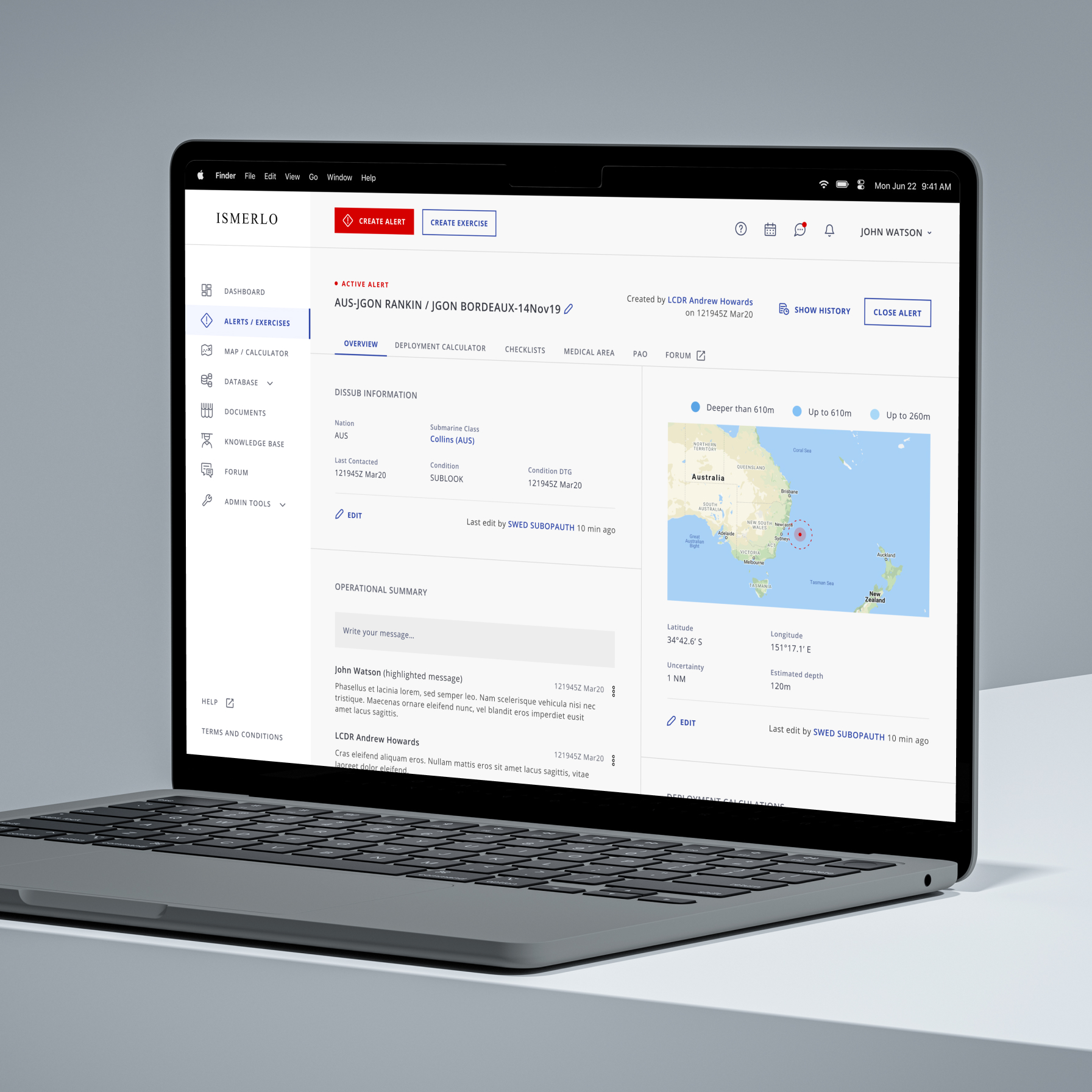
Our experience includes rebuilding and supporting ISMERLO, the platform for international submarine rescue coordination developed for the NATO Communications and Information Agency.
NATO ISMERLO
NATO's International Submarine Escape and Rescue Liaison Office (ISMERLO) plays a critical role in coordinating global submarine search and rescue operations. The organization's mission is to prevent peacetime submarine accidents and respond swiftly on an international scale when emergencies occur. However, their existing legacy system, which had served the international community for years, was becoming outdated and in need of a comprehensive update to continue supporting these vital operations effectively.
This system is not simple at all. There is a lot of highly technical detailed information in there, but they have done extremely well; they've delivered every single one of the requirements.
Which defence software services do we offer?
Custom application development
Take a web or mobile application from its initial concept to launch. Product discovery helps clarify requirements, while early designs give your specialists something concrete to review. Our engineers carry that understanding into architecture and development, with testing throughout the project.
Legacy software modernisation
Improve software that has become difficult to maintain or extend. We assess the existing application and its dependencies before recommending changes. That may mean replacing a component or rebuilding the platform, with data migration and the transition for current users planned as part of the work.
Software integration and data workflows
Connect applications and data sources around the information your teams need to exchange. Integration work includes handling failed transfers and conflicting updates, with access restrictions considered from the beginning.
Maintenance and further development
Keep the application supported as requirements change. The engagement can continue after launch, covering maintenance alongside agreed improvements. Responsibilities and response expectations are established around the needs of the system.
What can you expect from working with Kellton Europe?
Direct access to the development team
Your specialists can work through requirements with the engineers and designers building the application. A detail that seems minor in a specification may change how a workflow needs to behave. Direct conversations help the team understand why it matters and make an informed decision.
Time spent understanding your domain
In the ISMERLO project, our team had to learn how submarine rescue coordination works to translate operational requirements into software. We bring that same willingness to learn to a new engagement. Early designs give your specialists something concrete to question before an assumption becomes part of the application.
Delivery that accounts for formal review
Close collaboration can sit alongside a structured acceptance process. We establish review stages and testing responsibilities with your stakeholders, including any independent security assessment the project requires. This helps everyone understand what needs to be demonstrated before a release can be accepted.
Support beyond the initial delivery
Our involvement with ISMERLO continued into maintenance and further development. Staying involved gives the team context for later decisions, including why a particular workflow was designed in a certain way and what a proposed change may affect.
How do we approach security and controlled change?

Security requirements from the outset
Security requirements shape the application from the outset. We work with your stakeholders to understand how information should be protected and who needs access to it. Hosting restrictions and connections to other systems also inform the technical approach.
Checks built into development
Security checks form part of development, with automated tests and code analysis helping identify issues before release. Dependencies are checked for known vulnerabilities, and findings are reviewed by engineers to determine what needs attention.
Controlled releases
When updating software already in use, we assess how changes could affect existing workflows. We agree how each release will be verified against your acceptance requirements and plan how to restore the previous version if problems arise.

Applying AI in defence software
AI integration in defence software can help teams work with technical documentation and information received from different units or partner organisations. An assistant could help users find guidance in approved manuals, while document processing could extract details for someone to check before updating a record. We can help assess the use case and develop the feature around those requirements.
01 Start with a prototype
The first step is to establish whether AI can handle the task well enough to be useful. A prototype gives your team something to evaluate, including cases where information is missing or the model produces an incorrect answer.
02 Fit your data and hosting rules
Data access and hosting requirements shape which approaches are suitable.
03 Keep people in control
Where a feature proposes changes to operational records, an authorised person should be able to review and approve them.

Sebastian Spiegel
Backend Development Director
Thinking about adding AI to your product?
Tell us what you're working on and where AI comes into the picture. We'll look at the product, the data and the technical constraints, then tell you where we think it makes sense to use it.
FAQ
Questions, answered straight.
What types of defence software can Kellton Europe develop?
We develop custom web and mobile applications for defence organisations. Potential projects include resource planning tools and applications for managing information across teams. We also help modernise existing platforms and integrate software with other systems. The scope is defined around your requirements and the intended operating environment.
Can you modernise an existing defence software platform?
Yes. We start by assessing the existing application and its dependencies, then recommend whether to replace individual components or rebuild the platform. Data migration and the transition for current users are planned as part of the work, as we did when rebuilding ISMERLO.
How do you approach security in defence software development?
Security requirements shape the application from the outset. Automated tests, code analysis and dependency checks are part of development, with findings reviewed by engineers. For software already in use, we agree how each release will be verified and how to restore the previous version if problems arise.
Can AI be added to an existing defence application?
Yes, where the use case supports it. We start with a prototype to check whether AI can handle the task well enough to be useful, fit the approach to your data access and hosting requirements, and keep an authorised person in control of any proposed changes to operational records.

Dariusz Fryta
Managing Director
Tell us what you need your software to do
Share the challenge you’re working on, whether it involves an existing platform or a new application. We’ll help you assess the technical options and define a practical next step.